We are used to thinking of trauma as something that lives in our memory or our heart—as a sad experience that left an emotional mark. But the body has its own memory, too. It can store traces of what you went through even when your conscious mind has already "let go" of the situation. Sometimes, anxiety, muscle tension, sleep issues, or even unexplained physical pain aren't just random symptoms—they are signals that your body is still holding onto an unresolved experience.
In this article, we will look at why this happens and how you should respond to it.
What Is Body Memory
Body memory is the body's ability to retain traces of emotional or physical experiences in the form of physical sensations, tension, muscle reactions, and even pain. It's as if the body "remembers" what happened, even if the conscious mind tries to forget. You might not actively recall the event, but your body will react as if it is still happening.
Below are a few examples of how body memory can manifest:
- Hands trembling when you recall an unpleasant situation.
- Clenching your jaw when you feel tense or angry.
- Slouching your shoulders after prolonged stress or emotional fatigue.
- Numbness or parts of your body "shutting down" as a reaction to emotional overload.
- Holding your breath in response to anxious thoughts.
Here is what is happening inside the body during these moments:
Nervous System
Body memory occurs when the sympathetic nervous system (responsible for the "fight or flight" response) is activated but fails to complete its reaction due to severe or chronic stress.
Hormones
Stress hormones, like adrenaline and cortisol, affect your muscles, breathing, and heart rate. If the trauma is left unprocessed, the body can remain in "alarm mode" long after the threat has passed.
Muscle Memory
Muscles can "remember" habits and reactions to danger. For instance, chronic tension in your shoulders or neck isn't just bad posture; it is a defensive reaction that got "stuck."
How the Body Reacts to Trauma
When you find yourself in a stressful or dangerous situation, your body automatically triggers defensive responses—fight, flight, or freeze. These reactions are regulated by the nervous system and serve as an evolutionary survival mechanism. Once the threat passes, the body gradually returns to a state of balance. But if the trauma was too severe or prolonged, the body doesn't always have time to complete these defensive cycles. And so, they remain literally "stuck" in the body.
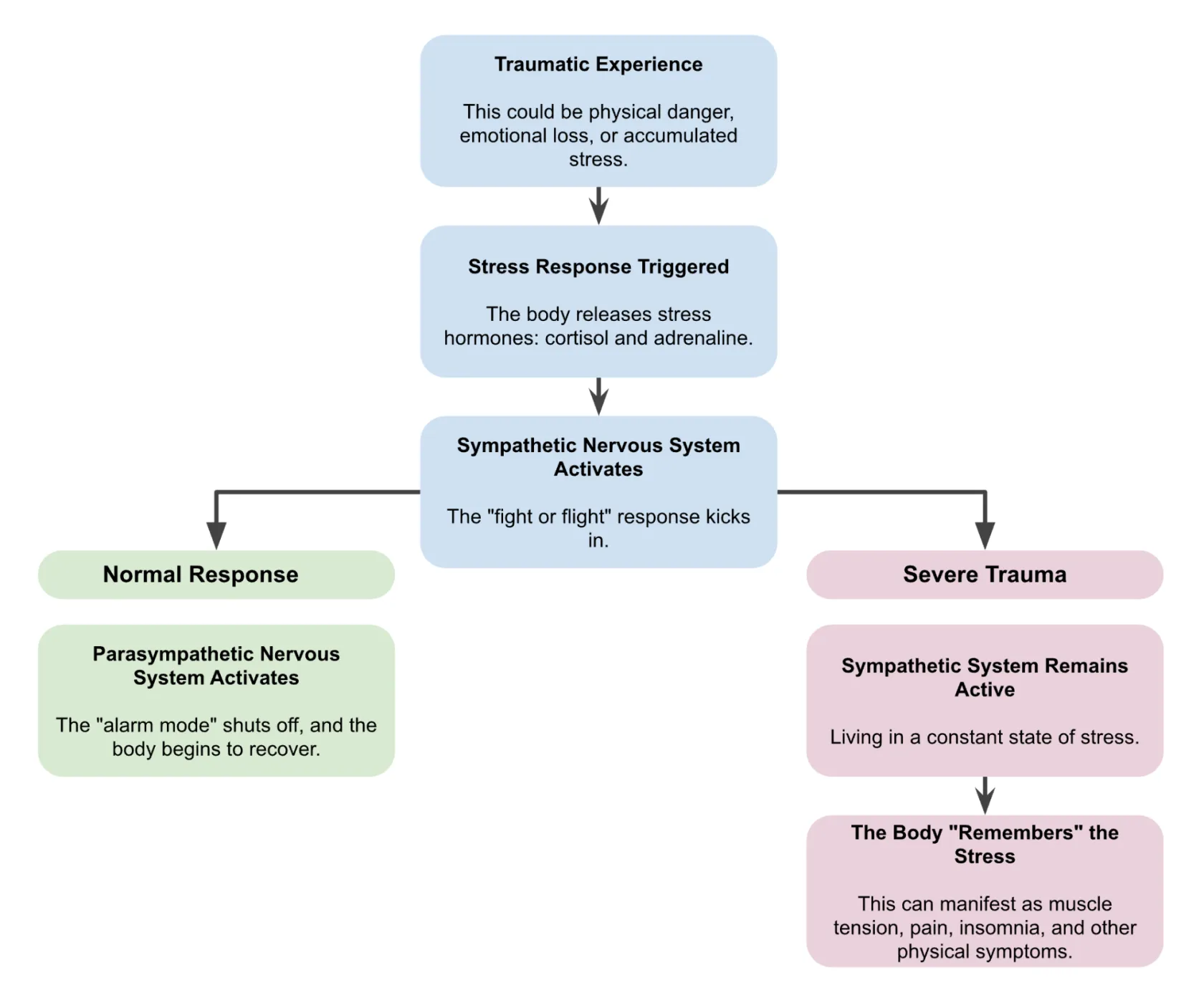
A traumatic experience can later manifest as chronic muscle tension, irregular breathing, digestive issues, or hypersensitivity to sounds and touch. Some people describe it as being in a constant state of high alert, even when there is objectively no danger.
How to Tell if Your Body Is Still Carrying Trauma
After severe stress or a traumatic event, the body can remain in a state of constant tension, even if we are no longer thinking about what happened. The memory of the trauma is stored not only in the mind but also in the body through reactions, sensations, and symptoms. Below are common signs that your body has not yet let go of the experience.
Constant Physical Tension
You might notice that you frequently clench your jaw, ball your fists, pull your shoulders up to your ears, or slouch. This isn't just a "habit"—it is muscle memory left over from experiencing danger.
Disruptions in Breathing and Heart Rate
Uneven or shallow breathing, holding your breath, or suddenly experiencing a racing heart while resting are common consequences of stress that the body hasn't been able to "release."
Reactions That Seem Excessive or Unexplained
You might experience sudden emotional outbursts: abrupt irritation, tears, or panic for no apparent reason. Or, conversely, you might feel absolutely nothing during difficult situations. This is also a form of bodily defense.
Feeling Like Your Body Is "Shutting Down"
Numbness, weakness, a lack of coordination, or even feeling like you are "not in your own body" are signs that your nervous system is trying to "protect" you from overload.
Chronic Fatigue or Pain Without a Medical Cause
Trauma exhausts the body. If you constantly feel tired or experience stomach, head, or back aches — even when doctors can't find a cause — it could be the result of emotional baggage that was never processed.
What Can Trigger a Bodily Reaction
Triggers are things that can activate an old trauma response in the body. This often happens automatically: the body essentially "recognizes" a threat, even if the conscious mind doesn't. Sometimes a person might not even remember the event, but their body still reacts to the stimulus.
What can act as a trigger?
- Smells. Scents similar to those present during the trauma (smoke, perfume, food).
- Sounds. Loud bangs, screams, noise, or music that remind you of the situation.
- Places or objects. A specific street, room, piece of furniture, vehicle, etc.
- People or their characteristics. A similar voice, clothing style, or manner of speaking.
- Situations. Similar events or even a general atmosphere (e.g., conflict, loneliness).
- Emotional states. Feelings of fear, helplessness, or shame can trigger a bodily reaction on their own.
It is important to understand that a reaction to a trigger is automatic and often defies conscious control. The body reacts as if the threat is real and happening right now. During this moment, familiar symptoms of body memory may appear: a racing heart, sweating, muscle tension, difficulty breathing, and so on.
How You Can Let Go of Trauma
You can't simply "forget" or "think your way out of" trauma using logic alone. As Bessel van der Kolk points out in his book "The Body Keeps the Score", when the body is locked in chronic stress or a "freeze" response, access to logical thinking can be severely restricted. That is exactly why the best path to healing often involves a combination of approaches focused on both the mind (top-down) and the body (bottom-up).
Here are the main methods that can help in the healing process:
Cognitive Therapies
These methods help identify and change the beliefs formed as a result of a traumatic experience. This might involve challenging thoughts like "there is something wrong with me" or "the world is dangerous."
Exposure Therapy
This therapy teaches a person to gradually approach traumatic memories, images, situations, and physical sensations rather than avoiding them. Over time, habituation occurs, and the brain learns to distinguish between the memory of danger and a real threat in the present. This method is especially recommended for PTSD.
EMDR (Eye Movement Desensitization and Reprocessing)
Eye Movement Desensitization and Reprocessing is an innovative therapeutic approach that uses rhythmic eye movements or other forms of bilateral stimulation (like tactile or auditory cues) to help process traumatic memories. This helps reduce the intensity of the emotional reaction to those memories.
Somatic Therapies
These approaches view the body as a crucial source of information about trauma. Such methods help you become aware of and release the physical tension linked to the traumatic experience. The focus is on bodily sensations, experiencing them, and gradually restoring physiological balance.
Movement and Breathwork
Regular physical activity, especially body-oriented practices like yoga, dancing, or slow stretching, can help lower stress levels and release tension stored in the body.
Breathing practices, specifically deep diaphragmatic breathing, activate the parasympathetic nervous system, which promotes relaxation and a sense of calm.
It is important to remember that the choice of therapeutic approach depends on individual needs, the specifics of the trauma experienced, and personal preferences. Often, the most effective route is combining different methods under the guidance of a qualified trauma specialist.
Conclusion
Our body is not just a shell; it is a delicate and sensitive vessel for our experiences. It is capable of storing things we might not even be fully aware of. Understanding body memory, paying close attention to your reactions, and gradually working through trauma help you reconnect with yourself, find your footing, and restore inner peace. Giving yourself the space to heal is not a sign of weakness — it is an act of immense strength and self-care.