Philosopher Eckhart Tolle once said: «When you become comfortable with uncertainty, a deep peace enters your life.»
Yet, we often live in a state of endless waiting, genuinely believing that this very peace will only come once we've calculated all the risks, secured reliable guarantees for the future, and safeguarded ourselves against any surprises. It seems like if we just gather a bit more information, devise one more backup plan, and double-check every step—then, finally, we can relax. However, this perfect moment of absolute certainty never arrives, because life itself, by its very nature, is pure uncertainty.
The Mirage of Stability
We are used to equating peace of mind with total control. It seems logical: if you keep your finger on the pulse, anticipate every possible scenario, and have a backup plan for any occasion, you are safe. However, this strategy has one major flaw—it requires constant tension. By trying to control what is inherently fluid, we only amplify our own anxiety.
The root of our stress often lies not in life's actual hardships, but in our reaction to situations where we don't know what happens next. Modern psychotherapy has a specific term for this phenomenon—Intolerance of Uncertainty (IoU).
Why does our brain react so acutely to a lack of information? From an evolutionary perspective, its primary goal isn't to make us happy, but to ensure our survival. To do this, it works as a prediction generator. The brain constantly scans the environment to construct a safe scenario. When information is lacking, the system crashes. Evolution taught us: if you don't know exactly what is hiding in the bushes, it's best to assume it's a predator.
This process, described in the fundamental neurobiology of anxiety model UAMA (Uncertainty and Anticipation Model of Anxiety), follows a clear algorithm. The mechanics of stress generation look like this:
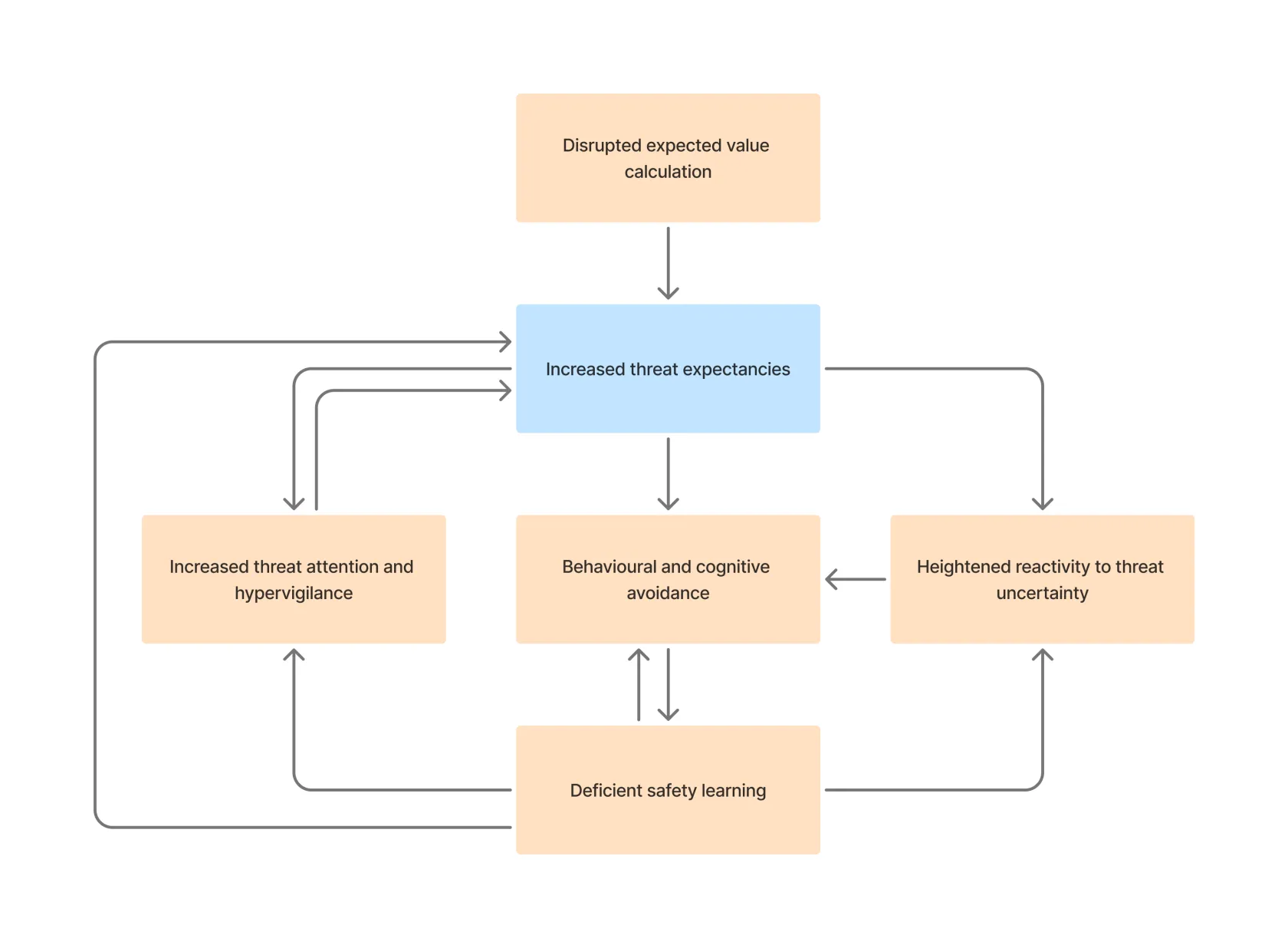
From a neurobiological standpoint, the brain operates on the principle of updating predictions. If a person anticipated danger and it didn't materialize, a healthy nervous system remembers this. The fear fades, and the situation gets tagged as "safe."
But scientists have proven that with high anxiety, this algorithm breaks down. Due to the prolonged expectation of danger, the brain loses its ability to effectively recognize signs of safety. Since the body spent a massive amount of resources preparing for a hypothetical catastrophe, the absence of this catastrophe brings neither relief nor retraining to the system. The brain simply doesn't register it as a positive experience.
The Paradox of Pain: Why a Guaranteed Shock is Better Than Waiting
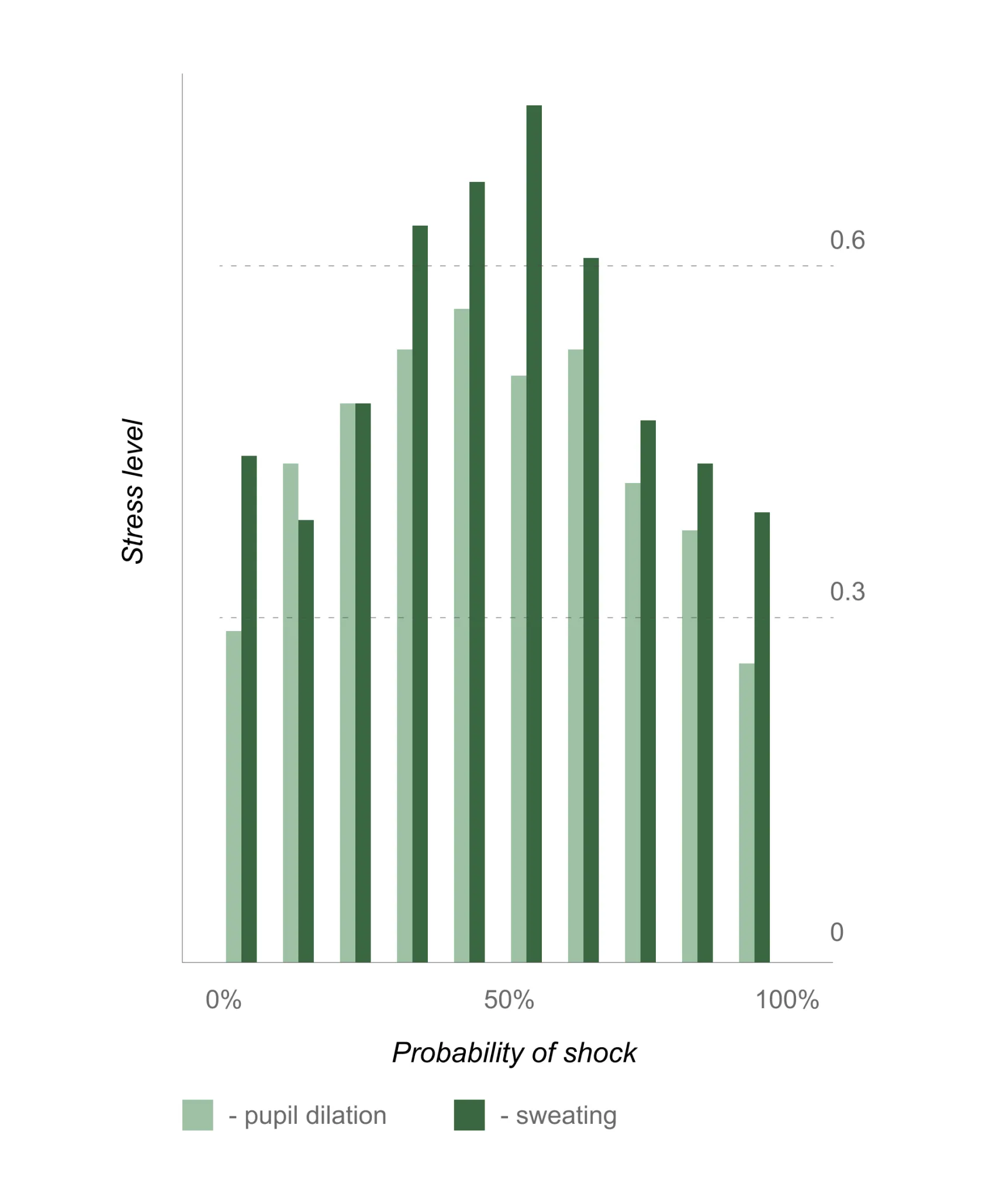
We've established that the brain hates uncertainty. But just how much? Neuroscientists at University College London found the answer in 2016. Participants in their experiment were asked to play a simple computer game. They had to turn over rocks, under which snakes might be hiding. If a player encountered a snake, they received a mild but unpleasant electric shock.
The main trick was the changing rules, which participants had to figure out as they went. In some rounds, there were no snakes at all (0% risk); in others, they were hiding under every rock (100% guarantee of a shock). But the hardest stages were those where the probability was exactly 50/50, and it was impossible to guess logically.
It would seem people should experience the most stress before inevitable pain—when the probability of a shock was 100%. However, medical sensors recorded an entirely paradoxical picture. The stress levels, measured by sweating and pupil dilation, reached their absolute peak precisely when the probability was 50%. It was physically and psychologically easier for people to accept guaranteed pain than to remain in a suspended state of anticipation.
The study authors also discovered an unexpected detail.
Those participants whose stress spiked the most during moments of total uncertainty evaluated the situation better and were better at guessing the presence of snakes.
As the study's senior author, Dr. Sven Bestmann, notes, from an evolutionary perspective, this provided a huge advantage. A sharp stress reaction to the unknown isn't a psychological glitch, but a powerful radar that helped our ancestors mobilize fully to explore unpredictable and dangerous environments.
The problem is that this evolutionary mechanism continues to operate in the modern world. The tension from "50/50" life situations becomes so unbearable for the brain that we often start winding ourselves up. We invent the worst, most catastrophic scenario and believe in it just to artificially create certainty for ourselves. It turns out to be easier for our psyche to believe in an imaginary catastrophe than to endure the exhausting state of not knowing.
Two Faces of the Same Fear
The reaction to uncertainty never remains solely at the level of hidden brain processes. It inevitably shapes our daily behavior. When the psyche faces an unbearable lack of information, it tries to protect itself at any cost. Depending on the specifics of the nervous system and established patterns, intolerance of uncertainty manifests through two opposite strategies: attempting to hyper-control everything around or falling into a complete stupor.
In clinical psychology, these behavioral reactions are classified as prospective and inhibitory anxiety. Both states are a desperate attempt by the psyche to defend against an unbearable lack of information, yet each strategy exhausts the nervous system in its own unique way.
Prospective Anxiety or the Trap of Hyper-Control
Prospective anxiety emerges as the brain's active attempt to turn the unknown into 100% certainty. It is a fighting strategy where a person tries to predict and rigidly control absolutely every possible scenario.
In practice, this manifests through obsessive information-seeking and over-preparing:
- continuously refreshing the news feed,
- Googling any symptoms of illness,
- excessive micromanagement at work,
- making plans A, B, and C for even the most unlikely problems.
From a psychological perspective, this state is accompanied by hypervigilance. The nervous system goes into a continuous environment-scanning mode. The brain is driven by a flawed logic: if you gather maximum data and prepare for every hypothetical threat, the risk of unpredictability will disappear, and peace will finally come.
However, this strategy creates only an illusion of safety. Since the future is objectively impossible to calculate down to the smallest detail, the brain's need for new data is never fully satisfied. Instead of the desired relaxation, a person gets total cognitive exhaustion, as their internal resources are spent daily analyzing an infinite number of variables they don't actually control.
Inhibitory Anxiety or the Strategy of Paralysis
If prospective anxiety is an attempt to overcome uncertainty with hyperactivity, inhibitory anxiety triggers the opposite mechanism: freezing. In this state, the prospect of an unpredictable outcome overloads the nervous system so much that the person subconsciously refuses to act at all.
Faced with a situation with no clear guarantees of success or safety, the brain chooses a complete halt. In real life, this takes the form of:
- deep procrastination,
- sabotaging deadlines,
- ignoring accumulated problems,
- an inability to make decisions (from changing careers to choosing a dish at a restaurant).
At this moment, the psyche is guided by a specific protective logic: "Any action creates new variables and leads into the unknown, so the safest thing is to do nothing." The brain physically blocks activity to avoid confronting a hypothetical threat.
Yet, the cost of such protection is exceptionally high. Refusing to make decisions doesn't eliminate the problem itself; it only puts it on pause. The situation of uncertainty doesn't go away and continues to generate background stress. As a result, a person might objectively do nothing, but still feel colossal exhaustion from constant psychological pressure and the loss of control over their own life.
The Bottom Line
Both prospective and inhibitory anxiety are just two sides of the same coin. Neither endless hyper-control nor total paralysis of action can solve the main problem: the future will always remain unpredictable. The real way out is not to learn to anticipate all the world's threats or to hide from them, but to change the nervous system's very reaction to the lack of information.
Checklist: Reaction to Uncertainty
Often, the impact of a lack of information goes unnoticed, and background anxiety is written off as ordinary fatigue or work stress. To check if the root of the problem lies in the intolerance of uncertainty, you can run a brief self-diagnostic.
Just carefully read these statements and note the ones that evoke instant internal agreement:
- Unforeseen events upset me greatly.
- Lacking all the necessary information throws me off balance.
- Uncertainty keeps me from living a full life.
- One should always look ahead to avoid surprises.
- It feels like even with perfect planning, one small detail can ruin everything.
- When it's time to act, uncertainty paralyzes me.
- It's impossible to function normally without a sense of certainty.
- There is a pressing need to know exactly what the future holds.
- Situations that catch me off guard are unbearable.
- The slightest doubt can stop me from taking a step.
- There is a need to keep everything under control and organized in advance.
- I feel a desire to avoid any unpredictable situations.
How to assess the result? If more than half of these statements feel painfully familiar, it's an important signal from the nervous system. It indicates a high level of intolerance of uncertainty. The psyche is spending too many resources fighting something that doesn't yet exist. It's time to pay attention to this and try to shift the focus.
Note: This list is adapted solely for self-reflection. It is not a medical tool for making a diagnosis. If anxiety becomes a constant background in your life, the best decision is to seek support from a mental health professional.
For fans of precise analytics who want an assessment based on the official clinical scale, the full interactive version of the IUS-12 test is available at this link.
Practices for Navigating the Unknown
Forcing the world to be predictable is impossible, but it is entirely possible to teach your own nervous system to react to changes without panic. The brain's neuroplasticity allows us to break the automatic "unknown = threat" chain through regular practice. Below are three techniques that help reduce tension.
Microdosing Uncertainty
Instead of avoiding unpredictable situations, this approach suggests consciously integrating them into everyday life under safe conditions. From the perspective of cognitive psychology, this is a process of rewiring the nervous system. It practically proves to the brain that the absence of a detailed plan does not equal disaster. The mechanics involve intentionally changing small things: ordering a random dish from the menu, going for a walk without a clear route, or watching a movie without reading reviews. Through such controlled encounters with the unknown, the psyche records a new, safe experience, and the emotional centers' hypersensitivity to a lack of information gradually decreases.
Scheduled Worry Time
Encountering the unknown often triggers rumination—the continuous looping of anxious thoughts, which can completely drain cognitive resources. The goal of this technique is not to suppress fear, but to strictly localize it. To do this, a limited time slot (for example, 15 minutes at 6:00 PM) is allocated specifically for analyzing worst-case scenarios. If an intrusive thought about the future arises in the middle of the day, you should simply write it down on paper and set it aside until the scheduled "window." This approach interrupts the cycle of constant threat-scanning and returns your focus to current tasks.
Playing Out the Worst-Case Scenario
The fear of the unpredictable feeds mostly on abstractness. The psyche constructs a blurry image of a catastrophe, followed by a dead end. To bring the nervous system out of paralysis, it's worth taking this hypothetical scenario to its logical conclusion by asking: "And what happens after that?" A detailed deconstruction of the worst-case scenario and the formation of a step-by-step action plan paradoxically lowers the tension level, and the abstract threat transforms into a concrete task.
Embracing the Unknown
Tolerance for uncertainty is not an innate characteristic of the nervous system—it's a skill that is entirely possible to develop. Transitioning from the need for total control to psychological flexibility takes time and systematic practice. However, it is precisely the ability to endure a lack of information that allows us to stop the endless anticipation of disasters. Reducing the fear of the unknown enables us to end the exhausting fight with a hypothetical future and shift our focus back to real life in the present moment.