
An ideal morning usually consists of simple rituals. Silence, a favorite mug, and the aroma of freshly brewed coffee that promises a calm start to a busy day. All that remains is to take the first sip. But one careless movement—and the hot beverage instantly spills across the table. It might seem like just a stain, easily wiped away with a napkin. Yet, instead of a quick fix, something snaps inside. Breath catches, a sharp wave of despair rolls in, and tears well up in the eyes. A mundane household mishap suddenly feels like a genuine catastrophe.
From the outside, such a reaction to spilled coffee seems exaggerated or disproportionate. It is often followed by a sense of guilt for one's own lack of restraint. In reality, an emotional outburst over such a minor thing has nothing to do with a weak character. It is a loud cry for help from an overloaded nervous system. When the mind operates on the edge for a long time, maintaining an illusion of complete stability and keeping a "convenient smile," its resources inevitably deplete.
In this state, any insignificant event can become a catalyst, the proverbial "last straw" that finally disrupts the balance. To understand why the body chooses such an abrupt method to release tension, it is worth looking at the physiology of stress. Modern science clearly explains where hidden feelings go and the price exacted for constant control.
How Background Stress Alters Our Body
Evolutionarily, the stress mechanism was designed as a short-term reaction for survival. A healthy cycle of the nervous system follows a clear sequence:
- the emergence of a threat,
- mobilization of all the body's resources,
- overcoming the danger,
- and most importantly, complete recovery.
Once the trigger disappears, physiological indicators return to the initial baseline level of stress—a state of absolute biological calm.
However, modern living conditions dictate a different rhythm. Work deadlines, information overload, background anxiety, and the need to constantly keep emotions in check create an endless chain of stimuli. Repeated stressful events overlap faster than the body can process them. This leads to a phase of incomplete recovery. There simply isn't enough time to lower anxiety hormones to a natural baseline. Over time, the body is forced to adapt to these conditions, forming a new, artificially elevated or altered baseline of stress.
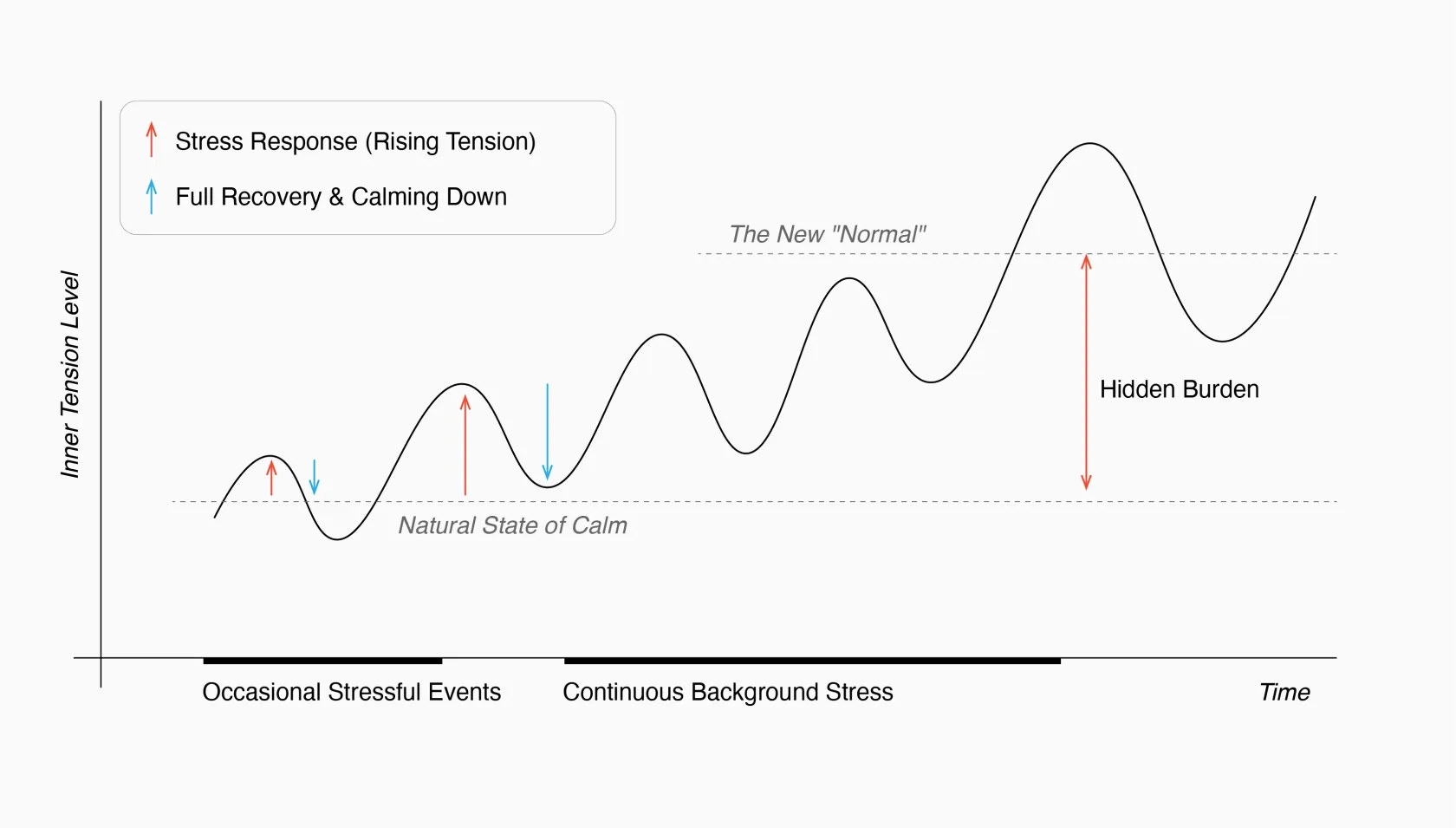
Graph created based on a study of biochemical markers of chronic stress.
In 1993, neuroendocrinologist Bruce McEwen and physiologist Eliot Stellar first described this phenomenon, introducing the term "allostatic load." The researchers defined it as the physiological wear and tear on the body caused by the constant need to maintain balance under chronic pressure. On a chronic stress accumulation graph, this load is visualized as the gap between the initial baseline of calm and the new, altered state. The wider this gap, the more resources the body expends simply to keep functioning.
Under high allostatic load, the body effectively operates on borrowed time. Cortisol and adrenaline levels remain steadily elevated, keeping internal systems in a state of high alert. The endocrine, immune, and cardiovascular systems begin to work to the point of exhaustion, trying to compensate for this invisible tension. In this state of chronic overload, the nervous system loses its flexibility.
Why the Internal Brakes Fail
The ability to remain calm and rationally assess a situation is ensured by the complex interaction of several brain areas. The prefrontal cortex is responsible for logic and self-regulation, while the hippocampus manages memory, learning, and the ability to see the objective context of events. Together, they act as a reliable braking mechanism for the amygdala—the center that detects danger and generates emotional reactions. In a stable state, this mechanism can quickly analyze a stimulus and dampen the alarm signal if there is no real threat.
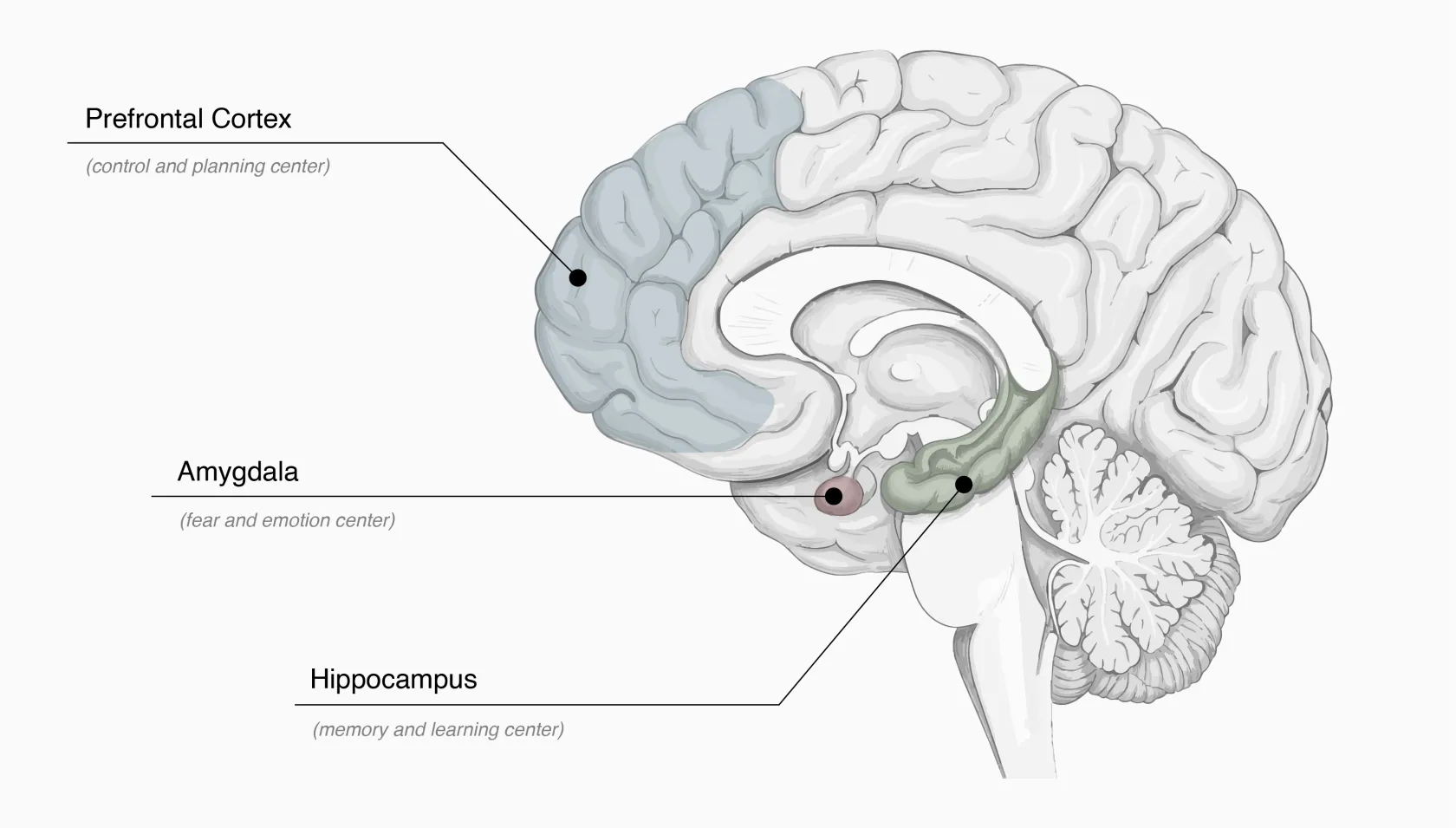
However, the brain possesses high neuroplasticity, meaning the ability to change its architecture under the influence of external conditions. Research by neurobiologist Bruce McEwen proves that chronic stress literally rebuilds these key zones, selectively degrading some structures while enlarging others.
Under the influence of prolonged tension, the prefrontal cortex and hippocampus gradually exhaust themselves. The connections between brain cells in these areas weaken and break down, and the process of forming new neurons slows significantly. Physically, this makes it much harder for the brain to process information:
- memory deteriorates,
- cognitive flexibility is lost,
- the ability to objectively assess reality disappears.
The amygdala reacts to chronic stress quite differently. Instead of depleting, it becomes hyperactive. The number of connections between cells in this zone grows rapidly. As a result, the emotion center transitions into a state of continuous vigilance and heightened fear, registering threats even where none actually exist.
A dangerous anatomical restructuring takes place.
The emotional alarm system becomes hypersensitive, while the centers of rational control and context analysis physically lose their neural capacity.
As a result of such a structural imbalance, the brain loses the ability to adequately gauge the scale of a problem. A mundane household annoyance instantly activates the hypertrophied anxiety center, which the weakened "internal brakes" are physiologically no longer able to stop.
The Cost of Hidden Emotions and the Contagion Effect
A logical question arises: what exactly is the brain spending so much resource on that it drives itself to structural exhaustion? The answer lies in the attempts to maintain an illusion of stability. There is a common belief that ignoring sadness or irritation will help them disappear faster. The habit of hiding one's true state behind a polite facade seems like a safe strategy. Yet, research by psychology professor James Gross on expressive suppression proves the opposite. It is precisely this attempt to look calm during internal discomfort that forms the same destructive allostatic load.
Maintaining the "I'm fine" illusion requires colossal work from the entire body. Gross's studies have shown that the conscious suppression of emotions strikes on two fronts simultaneously:
- Brain depletion. Maintaining artificial calm demands immense effort from the nervous system. Because of this, there are simply no resources left for ordinary tasks. Attention scatters, information is remembered more poorly, and the ability to think clearly and make sound decisions drops rapidly.
- Physical tension. A hidden state does not disappear; it shifts to the physical level. Even if absolute restraint is maintained externally, the heart begins to beat faster, blood pressure rises, and the body finds itself in a state of real stress.
The most interesting part is that this process affects not only the individual. Hidden tension is instantly noticed by those around them through imperceptible facial micro-movements and the work of mirror neurons (specific brain cells that allow us to subconsciously read and literally "mirror" the emotional state of others). Studies show an unexpected effect: during a conversation with someone actively suppressing their emotions, the interlocutor's blood pressure also begins to rise rapidly.
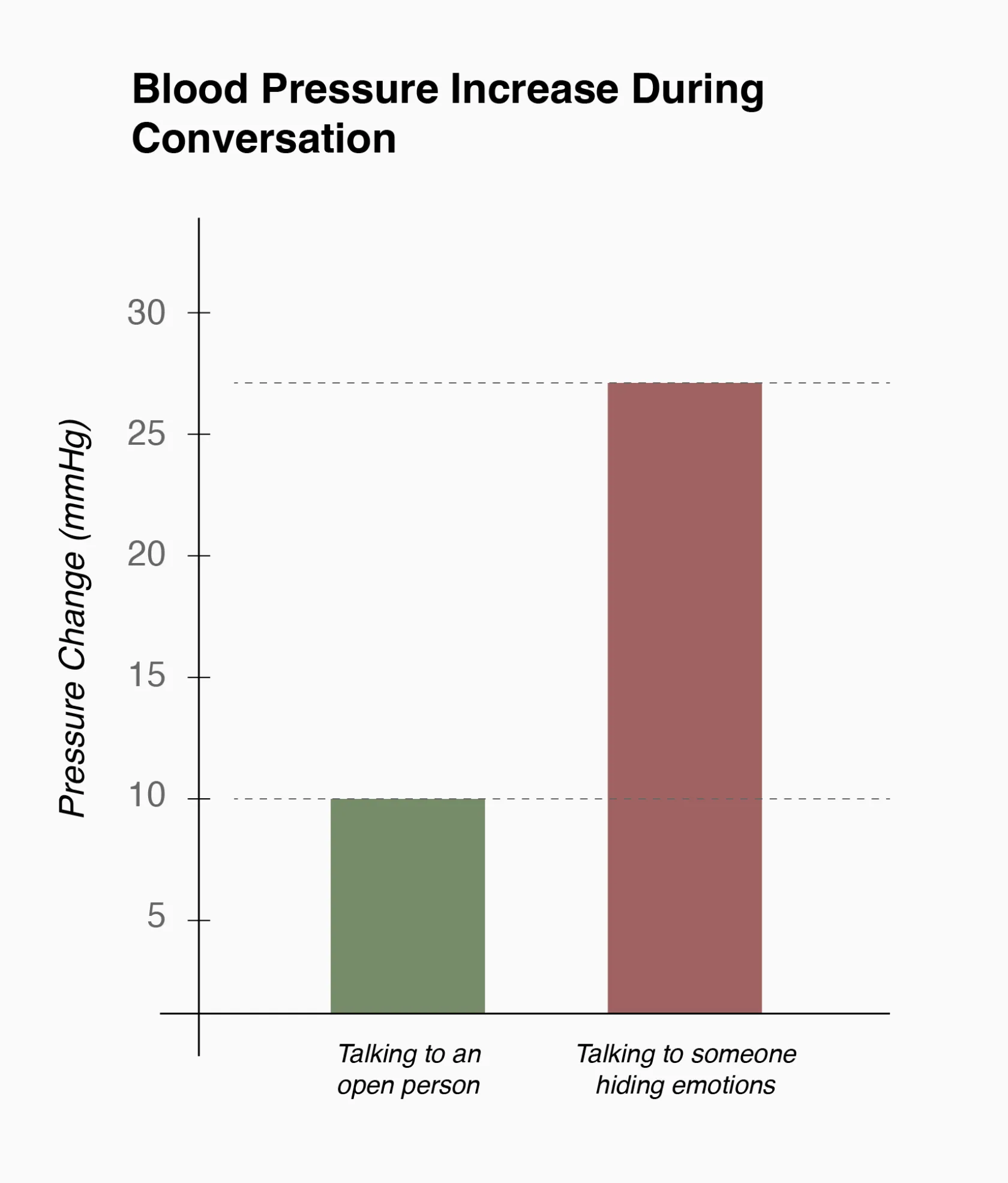
Adapted from the publication The Social Consequences of Expressive Suppression.
How to Regain Control: The 90-Second Rule
From a neurobiological perspective, any acute emotion is primarily a physiological reaction of the body. Exactly 90 seconds pass from the moment a trigger occurs (like that spilled coffee) to the complete breakdown of stress hormones in the bloodstream. This is a natural biological cycle necessary for the body to process the stimulus. If irritation, despair, or anxiety last longer, it only means that the mind is artificially feeding this state with intrusive thoughts or expending colossal resources fighting its own feelings.
The most effective strategy the moment internal tension peaks is not to hide it behind a polite smile, but to give the body those 90 seconds to process the emotion. Research by neurobiologist Matthew Lieberman suggests using the tool of "affect labeling." To reduce tension, it is enough to follow three simple steps:
- Observation without judgment. Instead of trying to calm down instantly, it is necessary to allow the emotion to simply unfold. Without judging one's own reaction and without feeling guilty for losing control.
- Verbal acknowledgment. The state must be named with clear words. It is enough to formulate a short phrase aloud or mentally: "Right now, strong anger is felt," "This is incredible fatigue," or "Acute fear is present."
- Refusal to analyze. During these 90 seconds, it is crucial not to look for someone to blame, not to analyze the causes of the event, and not to forecast the consequences. All attention is directed solely at stating the fact that the emotion is present.
Such simple labeling of feelings has a powerful physiological basis. Studies show that at the moment a state is verbalized, the activity of the anxiety center drops sharply, and blood flow returns to the prefrontal cortex (the center of logic and self-regulation). Acknowledging the truth about one's state acts as a natural braking mechanism for the nervous system, allowing internal pressure to be safely released.
The Right Not to Be Okay
The constant need to feign calm and hide one's vulnerability turns out to be an overly exhausting and destructive strategy for the body. True stability is built not on rigid self-control or suppression, but on acceptance. The ability to feel and process the entire spectrum of emotions is a basic biological need, not a sign of weakness or a loss of control.
Sometimes the most important action for maintaining the health of the nervous system is simply to stop fighting oneself. The special practices in the Plyn app were created precisely to develop the skill of healthily processing emotions. They help navigate emotional peaks, release accumulated tension in time, and learn to accept one's true state. Instead of wasting energy maintaining an illusion of absolute balance, Plyn provides tools for the honest recognition and labeling of feelings. This is the first and most vital step to stop exhausting oneself and restore the capacity for an objective assessment of reality.